How to Start Praying Again, Even If It's Been Years
If you stopped praying, for a week or for ten years, you are far from alone, and the way back is shorter than it feels. You do not need to fix your whole life first or make up for everything before you are allowed to begin. You need one thing: the next prayer. This guide is about how to start again, what to do about the prayers you missed, and how to keep going when you slip.
The door is still open
The Qur'an addresses people in exactly this position: "Say, 'O My servants who have transgressed against themselves [by sinning], do not despair of the mercy of Allah. Indeed, Allah forgives all sins. Indeed, it is He who is the Forgiving, the Merciful'" (Qur'an 39:53).
The Prophet ﷺ described Allah's reaction to a returning servant as joy: "Allah is more pleased with the repentance of His slave than anyone of you is pleased with finding his camel which he had lost in the desert" (Bukhari 6309). In a hadith qudsi Allah says, "I am just as My slave thinks I am" (Bukhari 7405). Think well of Him, and walk back in.
Coming back is not failure. That is tawbah in action, and it is something the best of people do many times in a life.
Why people stop praying (and why it's so common)
Almost nobody decides to stop praying. It happens in small steps: a busy week, a missed Fajr that becomes a missed day, a move, a new job, a loss, doubts nobody answered, or simply forgetting how. Then shame arrives, and shame is the real wall. The longer you have been away, the more it feels like you have lost the right to return.
You haven't. And if low mood, anxiety or intrusive religious thoughts (waswas) are part of why you stopped, please talk to someone as well: a doctor, a counsellor, or a trusted imam. Prayer and professional help are not opposites, and you are allowed both.
Step 1: Make tawbah, simply
Tawbah is between you and Allah. Nobody else needs to be told or involved. Scholars describe its core as three things: regret for what happened, stopping it, and resolving not to go back. Then ask for forgiveness in your own words, or with the dua the Prophet ﷺ called the best way of asking forgiveness, Sayyid al-Istighfar, which begins Allāhumma anta Rabbī, lā ilāha illā ant, khalaqtanī wa ana ʿabduk (in meaning: O Allah, You are my Lord, none has the right to be worshipped but You; You created me and I am Your servant) (Bukhari 6306).
Don't wait for the feeling of being forgiven before you pray. The prayer is part of the tawbah.
Step 2: Pray the very next prayer
Not on Monday, not at the start of Ramadan, not once you have read three books. Check which prayer's time you are in right now, make wudu and pray it. If you are unsure of the times where you live, our prayer times guide explains how they are calculated.
Your first prayer back may feel clumsy or empty. That is fine. You are not performing for anyone; you are turning up. Then pray the next one, and the one after that.
Step 3: Relearn without embarrassment
Many people who return have forgotten parts of the prayer, or were never taught properly. Relearning as an adult is normal and nothing to be ashamed of. Our step-by-step guide to praying salah walks through wudu, the rak'ahs of each prayer and every position, and Hayya's Learn to Pray section takes you through all nine stages, from niyyah to tasleem, in Arabic, transliteration and meaning, so the words start to mean something again.
What about the prayers I missed?
This is the question that keeps many people from starting, so here is an honest summary. It is not a ruling, and it is worth taking to a scholar you trust.
- Prayers missed by sleeping or forgetting are prayed as soon as you remember. The Prophet ﷺ said, "If anyone forgets a prayer he should pray that prayer when he remembers it" (Bukhari 597).
- Years of prayers left deliberately: many scholars, including the four Sunni schools as they are usually taught, hold that they should be made up (qada), steadily over time. Others, including Sheikh Ibn Baz, Ibn 'Uthaymin and al-Albani, held that a person who deliberately left prayer and then repents sincerely is not required to make up those years, and should increase voluntary prayers and good deeds instead (Ibn Baz, fatwa 15981; IslamQA 111783).
Whichever view you follow, the first step is identical: start praying today's prayers, on time. If you are making up prayers, our qada guide and qada calculator turn a frightening number into a daily rhythm.
A gentle 4-week plan
- Week 1: all five, anywhere in their time. Don't worry about praying early or long. Pray each prayer at some point inside its window, and if one slips, pray it as soon as you remember and carry on.
- Week 2: earlier in the window. The Prophet ﷺ was asked which deed is dearest to Allah and said, "To offer the prayers at their early stated fixed times" (Bukhari 527). Earlier is also easier, because the day hasn't had time to crowd it out.
- Week 3: one small addition. The two sunnah rak'ahs before Fajr, or a short dhikr after each prayer. Just one.
- Week 4: pray with someone. One prayer at the mosque, or with family at home. Prayer is easier to keep when it is shared.
When you slip again (you probably will)
Expect a bad day. What decides whether you keep going is what you do the day after. Use the habit rule of never miss twice: one missed prayer is a slip; two in a row starts a new pattern. Pray the next one on time and make up the missed one.
The Prophet ﷺ said "the most beloved deed to Allah is the most regular and constant even if it were little" (Bukhari 6464). Consistency, not perfection, is the goal. Our guide to being consistent in salah goes deeper on the habit side, and no motivation to pray? covers the days it feels heavy.
How Hayya helps you come back
Hayya was built around returning; the line on our homepage is "the next prayer is a good place to start again". The features follow from that:
- Prayer times and gentle reminders, calculated on your phone, so you always know which prayer is next.
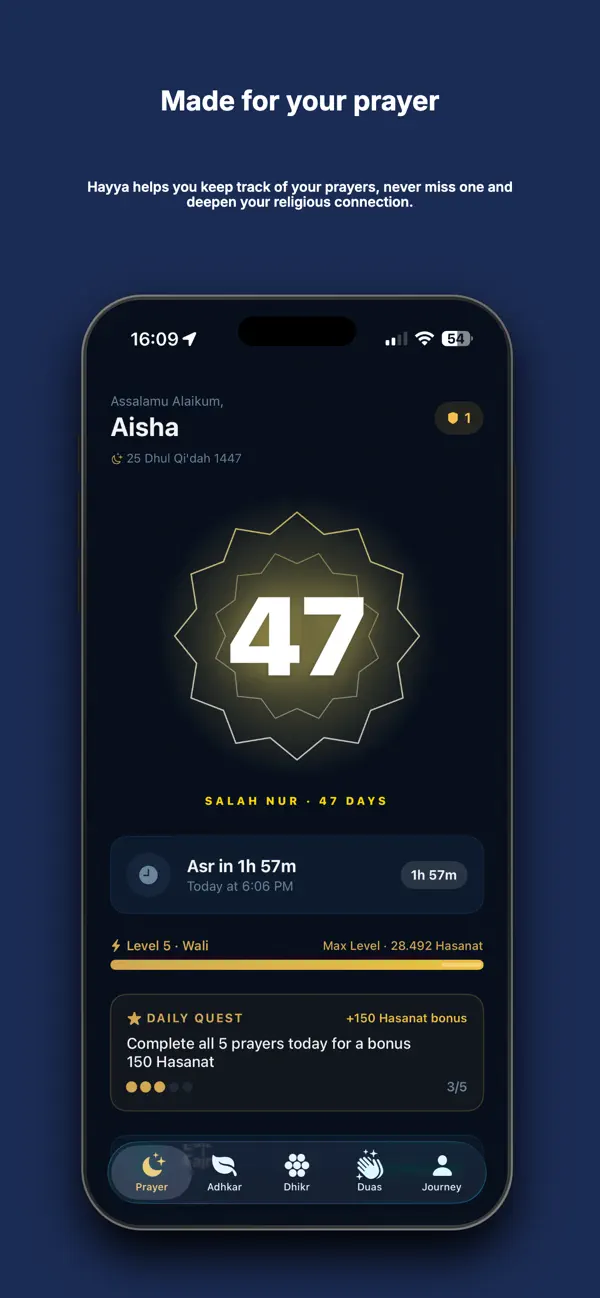
- One-tap logging and a Salah Nur streak, so progress is something you can see.
- A weekly Tawbah Token that protects your streak when a day goes wrong, so one slip doesn't wipe out weeks.
- A Qada tracker, if you are making up prayers.
- Salah Lock (Pro), which pauses the apps you choose during each prayer window if scrolling is what pulls you away.

The next prayer is a good place to start again
Prayer times, one-tap logging and a streak that forgives a hard day. Free to download, no ads, and your prayer data stays on your phone.
Download Hayya FreeFAQ
Will Allah forgive me for not praying for years?
The Qur'an says: "do not despair of the mercy of Allah. Indeed, Allah forgives all sins" (39:53), and the Prophet said Allah is more pleased with a servant's repentance than a traveller who finds his lost camel (Bukhari 6309). Sincere tawbah means regretting it, stopping, and resolving not to return, and the clearest sign of it is praying the next prayer.
Do I have to make up all the prayers I missed?
Scholars differ. Many, including the four Sunni schools as they are usually taught, hold that missed obligatory prayers should be made up steadily over time. Others, including Sheikh Ibn Baz, Ibn 'Uthaymin and al-Albani, held that someone who deliberately abandoned prayer for years and then repents sincerely is not required to make up those years, and should increase voluntary prayers instead. Ask a scholar you trust, and start with today's prayers either way. Our qada guide explains how to make up prayers if you do.
I've forgotten how to pray. Where do I start?
Start with the basics: wudu, the number of rak'ahs in each prayer, and the movements of one rak'ah. Our step-by-step guide to praying salah covers all of it for beginners, and it is completely normal to relearn as an adult.
What dua can I make when coming back to prayer?
Sayyid al-Istighfar, the best way of asking forgiveness (Bukhari 6306), and the dua the Prophet taught Mu'adh for after every prayer: "O Allah, help me in remembering You, in giving You thanks, and worshipping You well" (Abu Dawud 1522).
Should I wait until I'm a better Muslim before I start praying again?
No. Prayer is how people get better, not a reward for already being good: the Qur'an says "prayer prohibits immorality and wrongdoing" (29:45). Waiting until you feel ready usually means waiting forever.
When do I start praying again after my period?
Once your period has ended and you have done ghusl, you return to the five daily prayers. The prayers during your period are not made up ('Aishah, Muslim 335). Some details differ between schools, such as whether Dhuhr is also owed when the bleeding stops during the time of Asr, so check with a scholar you trust.