Feeling Lazy to Pray? Why Salah Feels Heavy, and How to Pray Anyway
Some days salah feels light. Other days, standing up for it feels like the hardest thing you will do. If you are searching for motivation to pray, you are not a bad Muslim; you are a normal one. Even the Qur'an acknowledges the weight: "seek help through patience and prayer, and indeed, it is difficult except for the humbly submissive" (Qur'an 2:45). Here are the honest reasons prayer feels heavy, and what helps.
Why prayer feels heavy: the honest reasons
- Friction. Wudu, finding a clean place, the qibla, the phone in your hand. Every small step between the adhan and the prayer is a chance to postpone.
- All-or-nothing thinking. You missed Asr, so the day feels ruined, so Maghrib feels pointless. One miss quietly becomes three.
- Not knowing what you are saying. Prayer in words you don't understand can feel like a routine to get through rather than a conversation.
- Sleep and schedule. Late nights make Fajr a fight, and long workdays bury Dhuhr and Asr.
- A dry patch in your iman. Everyone has seasons where faith feels quieter. They pass more quickly when you keep praying through them.
- Stress, burnout or low mood. When everything feels heavy, prayer does too (more on this below).
Don't wait to feel like it
Motivation usually comes after action, not before it. Most people who pray consistently are not more motivated than you; they have made the first step automatic, so they don't need to feel like it. Start the prayer and the feeling often follows; wait for the feeling and the prayer often doesn't happen.
Laziness is also a human state the Prophet ﷺ himself sought protection from: "O Allah! I seek refuge with You from incapacity and laziness" (Bukhari 6367). It is something to work against, not a verdict on who you are.
10 small fixes that actually help
- Stand up at the adhan. Don't negotiate with yourself sitting down. Stand, walk to the sink and start wudu; the rest follows.
- Pray at the start of the window. Asked which deed is dearest to Allah, the Prophet ﷺ said: "To offer the prayers at their early stated fixed times" (Bukhari 527). Early is also easier: the later it gets, the more the day crowds it out.
- Put the phone out of reach. Scrolling is the most common reason five minutes becomes an hour. Leave it in another room, or let Salah Lock pause your distracting apps during each prayer window.
- Leave your mat down. A spot that is always ready removes a step. Keep a second mat at work or in the car if you can.
- Attach each prayer to something you already do. "When I break for lunch, I pray Dhuhr before I eat." Pre-deciding the trigger makes it far more likely to happen.
- Learn what you are saying. Start with the meaning of Al-Fatihah, which you recite in every rak'ah. Understanding turns the words into a conversation.
- Pray with someone. Family, a friend, a colleague, the local mosque. Shared prayers are much harder to skip.
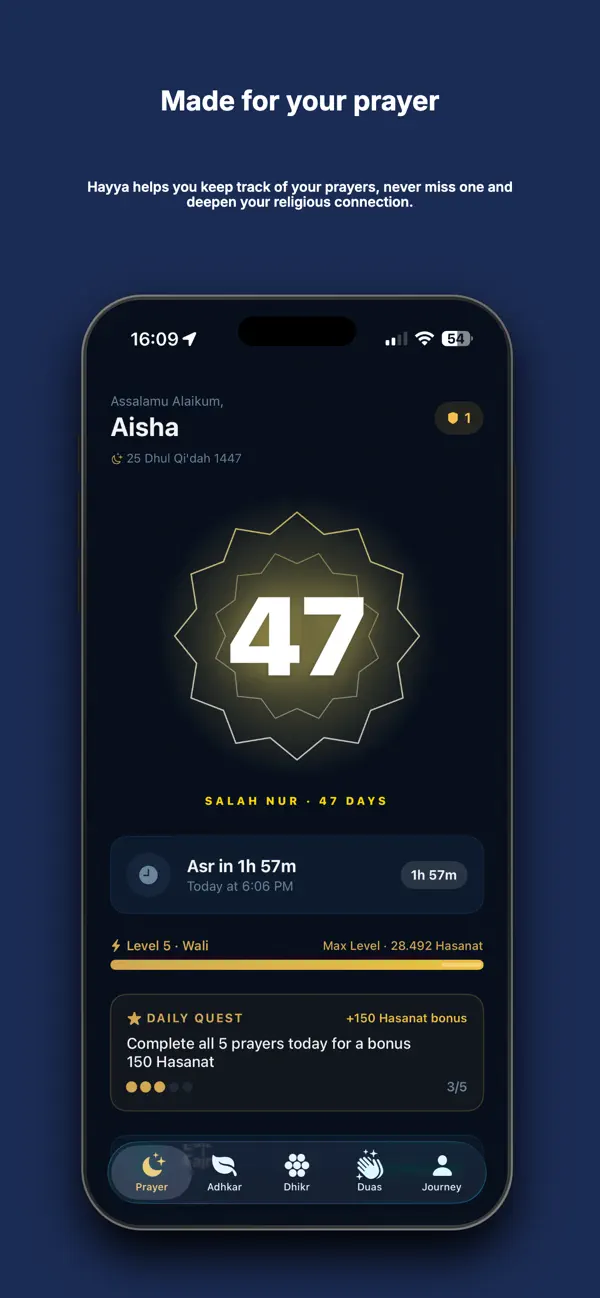
- Make your progress visible. Logging each prayer, on paper or in an app, gives the habit side of your brain a small, honest win.
- On a heavy day, keep it simple, but pray. Pray the obligatory prayer calmly and keep the voluntary extras for a better day. A short prayer prayed beats a long one postponed.
- Ask Allah for help with it. "O Allah, help me in remembering You, in giving You thanks, and worshipping You well" (Abu Dawud 1522), and Ibrahim's dua: "My Lord, make me an establisher of prayer" (Qur'an 14:40).
Reasons to pray that don't run on guilt
Guilt can get you up once. Over years, love and need last longer. A few of the reasons the Prophet ﷺ and the Qur'an give:
- Rest. The Prophet ﷺ said, "O Bilal, call iqamah for prayer: give us comfort by it" (Abu Dawud 4985). Prayer was where he rested, not a task he got through.
- Closeness. "The nearest a servant comes to his Lord is when he is prostrating himself, so make supplication" (Muslim 482). Sujud is the place to put down whatever you are carrying.
- A fresh start five times a day. He asked whether any dirt would remain on someone who bathed five times a day in a river at their door. The companions said, "Not a trace of dirt would be left," and he said that is the example of the five prayers (Bukhari 528).
- Help with everything else. "O you who have believed, seek help through patience and prayer. Indeed, Allah is with the patient" (Qur'an 2:153).
When it's more than laziness
Sometimes "I feel too lazy to pray" is really "I feel too low to do anything". If you have lost interest in most things, sleep badly, feel hopeless, or are caught in anxious, intrusive religious thoughts (waswas), please speak to a doctor, a counsellor, or a Muslim mental-health service in your country. Prayer and professional help are not opposites; many people need both, and asking for help is not a lack of faith.
On those days, be gentle with yourself. Pray what you can, as simply as you can, and keep the door open.
Helping someone else who struggles to pray
If it's your spouse, a friend or a teenager, invitation works better than pressure. Pray where they can see you, ask them to join you for one prayer rather than all five, and keep it warm. People rarely return to prayer because they were made to feel guilty; they return because it was made easy and someone they love went with them. For children, see our guide to teaching kids salah.
How Hayya helps on low days
Hayya is designed for the days motivation is missing:
- Prayer times and reminders calculated on your phone, so the cue is never buried.
- Salah Lock (Pro) pauses the apps you choose during each prayer window and unlocks when you log the prayer, with an emergency dismiss if you genuinely need your phone.
- A streak that forgives: a weekly Tawbah Token protects your streak when a day goes wrong, so one slip doesn't turn into giving up.
- A quick khushu check-in after each prayer. Pro adds private notes and a weekly report, so you can see your focus change over time.

For the days it feels heavy
Gentle reminders, Salah Lock for the phone, and a prayer streak with mercy built in. Free to download, with no ads.
Download Hayya FreeFAQ
Why do I feel lazy to pray?
Usually for ordinary reasons: friction (wudu, finding a place, the phone in your hand), tiredness, an all-or-nothing feeling after missing a prayer, not understanding what you recite, or a dry spell in your iman. The Qur'an itself says prayer is "difficult except for the humbly submissive" (2:45), so the heaviness is expected, not a sign that something is wrong with you.
Is my prayer valid if I don't feel anything?
Most scholars hold that feeling nothing does not undo a prayer you performed properly. They describe khushu, presence of heart, as the soul of the prayer and something to work towards, not a feeling you have to have before you are allowed to start. Our khushu guide covers practical ways to build it.
What dua helps with laziness in prayer?
The Prophet used to seek refuge from laziness: "O Allah! I seek refuge with You from incapacity and laziness" (Bukhari 6367). He also taught Mu'adh to say after every prayer: "O Allah, help me in remembering You, in giving You thanks, and worshipping You well" (Abu Dawud 1522). Ibrahim's dua in the Qur'an is another: "My Lord, make me an establisher of prayer" (14:40).
How do I motivate myself to pray 5 times a day?
Stop waiting for motivation and lower the friction instead: stand up at the adhan, pray at the start of the window, keep your mat down and your phone away, and attach each prayer to something you already do. Motivation tends to follow the action, not come before it.
Why is Fajr the hardest prayer?
Because it asks you to leave sleep, the most comfortable state there is, often in the dark. It gets easier with an earlier bedtime, an alarm away from the bed, and a plan for the first two minutes after waking. Our Fajr guide has a full system.
How can I encourage my husband, wife or a friend to pray?
Invite rather than pressure. Pray where they can see you, ask them to join one prayer rather than all five, and make it easy and warm. Lectures tend to push people away; shared prayers bring them closer.