Mawlid al-Nabi and Rabi al-Awwal: Dates, Meaning and the Scholarly Views
Rabi al-Awwal is the third month of the Hijri calendar, and its 12th day, the date most widely associated with the Prophet's ﷺ birth, is when many Muslims mark the Mawlid. In 1449 AH the month is expected to begin on Tuesday, August 3, 2027, which puts 12 Rabi al-Awwal on Saturday, August 14, 2027 (Umm al-Qura calendar; local moonsighting can move it by a day). Here's what the month means, how scholars differ on celebrating the Mawlid, and how to make the month count.
Mawlid dates by year
| Hijri year | 1 Rabi al-Awwal | 12 Rabi al-Awwal (Mawlid al-Nabi) |
|---|---|---|
| 1448 AH | Friday, August 14, 2026 | Tuesday, August 25, 2026 |
| 1449 AH | Tuesday, August 3, 2027 | Saturday, August 14, 2027 |
| 1450 AH | Sunday, July 23, 2028 | Thursday, August 3, 2028 |
The dates follow the Umm al-Qura calendar used in Saudi Arabia. The Hijri year is about 11 days shorter than the solar year, so the Mawlid arrives about 11 days earlier each Gregorian year. As with every Hijri month, the calendar date is a calculation and the moon has the final word — expect your mosque's announcement to confirm the start. The full year's table is in our Islamic Calendar 2026 guide.
Why the Mawlid date differs by country
Countries that begin the month on a local moonsighting can land a day either side of the Umm al-Qura date, so the Mawlid is not always marked on the same day everywhere.
| Country / region | How the month usually begins |
|---|---|
| Saudi Arabia | Umm al-Qura calculation |
| UAE, Qatar, Kuwait, Bahrain | Umm al-Qura / regional sighting |
| Egypt, Jordan, Morocco | Local sighting committee |
| Algeria, Tunisia, Libya | Local sighting committee |
| Pakistan, India, Bangladesh | Local sighting (often a day later) |
| Indonesia, Malaysia | Local sighting / hisab |
| Turkey | Diyanet calculation |
| UK, Europe, North America | Varies by mosque and body |
If the exact day matters for you — a fast, a gathering, a day off — take your local mosque's announcement over any calendar, this one included.
Why Rabi al-Awwal matters
Rabi al-Awwal ("the first spring") is honored across the Muslim world as the month of the Prophet's ﷺ birth in Makkah in the Year of the Elephant. It is also, by most historical accounts, the month of his arrival in Madinah after the Hijrah and the month of his passing — the month, in other words, that frames the entire prophetic story. Unlike Ramadan or Dhul-Hijjah, Rabi al-Awwal carries no prescribed rituals: no obligatory fast, no special prayer. Its significance is relational rather than ritual — a yearly prompt to ask how well we actually know, love and follow the man ﷺ whose life defines ours.
The Mawlid: the range of scholarly views, honestly
Whether to mark the 12th with a celebration is a genuine, centuries-old scholarly difference, and it deserves an honest summary rather than a verdict from a prayer-app blog.
The view in favor: many scholars, classical and contemporary — including respected voices in the Shafi'i and Maliki traditions — held that gathering to recite the seerah, send salawat, feed people, and express gratitude for the Prophet's ﷺ birth is a praiseworthy expression of love, provided it contains nothing contrary to the sharia (Dar al-Ifta al-Misriyyah, citing al-Suyuti's treatise on the Mawlid; Shaykh Abdullah bin Bayyah, Maliki). Large parts of the Muslim world observe it this way, from family gatherings to public celebrations.
The view against: other scholars hold that designating the day for celebration is a religious innovation (bid'ah), since the Prophet ﷺ and the early generations did not observe it — and that the sincerest way to honor him is precise adherence to his sunnah (Shaykh Ibn Baz, "Warning Against Innovations"). Communities following this view typically spend the month in ordinary worship, perhaps with extra seerah study, but without a designated celebration.
Where everyone agrees is the part that matters most: loving the Prophet ﷺ is a condition of faith (Sahih al-Bukhari 15), sending salawat upon him is commanded in the Quran (33:56), and studying his life is rewarded in any month. Follow the scholars and community you trust locally, and extend good assumptions to Muslims who conclude differently — this is a classic difference of opinion, not a fault line.
Practical ways to honor the month
Increase your salawat
The one act everyone recommends, in this month and every other, is sending blessings on the Prophet ﷺ — Allahumma salli ala Muhammad wa ala ali Muhammad, the opening of the salawat he taught his companions (Sahih al-Bukhari 3370). Set a daily target (100 is a common one) and count it however you like; Hayya's built-in dhikr counter works offline and keeps a running tally, so a target becomes a habit rather than an intention.

Study the seerah
Pick one biography of the Prophet ﷺ and actually finish it during the month — or one podcast series, or a chapter a night with your kids. Knowing the man makes every other act of worship more grounded. His birth month is the natural time to start.
Fast Mondays, if you can
When asked about fasting on Mondays, the Prophet ﷺ said it was the day he was born (Sahih Muslim 1162). Monday fasting is a year-round sunnah with special resonance in Rabi al-Awwal — a way of marking his birth that both sides of the Mawlid debate accept. Our fasting tracker guide covers building the Monday/Thursday habit.
Build the consistency he ﷺ taught
The Prophet's ﷺ own standard for beloved deeds was consistency — the most beloved deeds to Allah are the most constant, even if small (Sahih al-Bukhari 6464). There is no more direct way to honor him than five prayers, on time, every day, including the unglamorous weeks after the month ends. If that's the habit you want to leave Rabi al-Awwal with, a streak you can see helps it outlast the month.
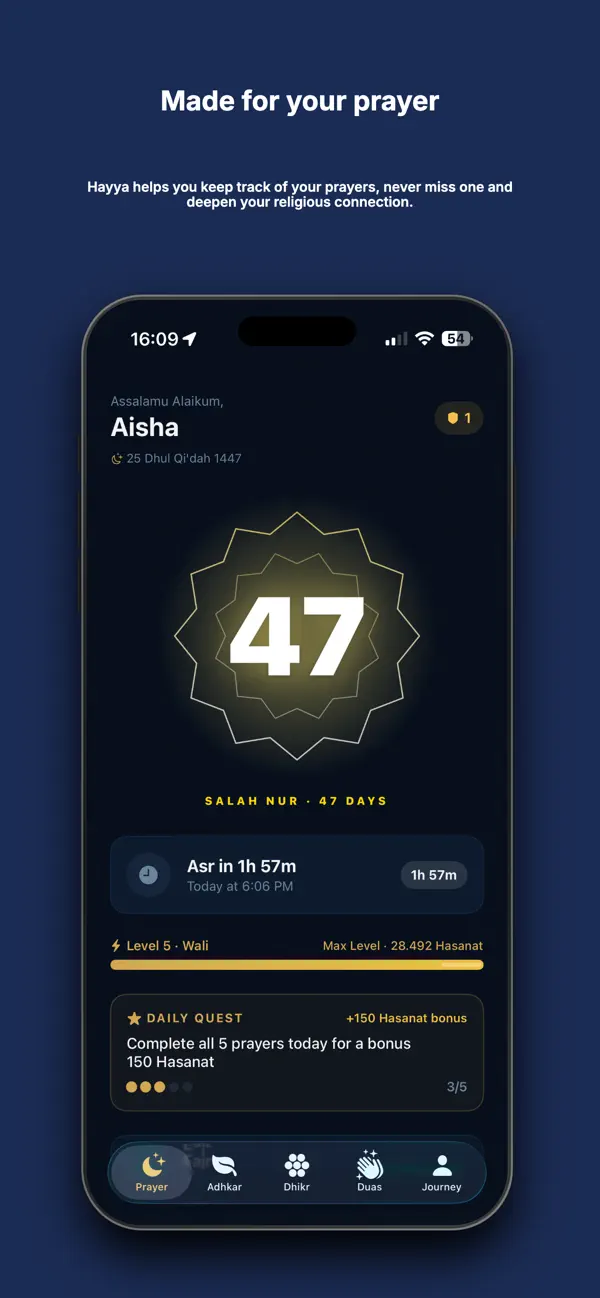

Make this the month consistency sticks
Prayer times, one-tap logging, dhikr counter for your daily salawat, and a streak with mercy. Free, no ads, offline.
Download Hayya FreeA month without rituals is an invitation
It's easy to treat non-Ramadan months as spiritual off-seasons. Rabi al-Awwal resists that: it hands you no obligations, only a person ﷺ — and asks what you'll do about him. A salawat counter ticking upward, a seerah book finished, a Monday fast, thirty days of Fajr on time: none of it is spectacular, and all of it is precisely the kind of small, steady deed he described as most beloved. Start when the month begins and aim to still be going when Rabi al-Thani does.
Sources
- Qur'an 33:56: the command to send blessings on the Prophet ﷺ
- Sahih al-Bukhari 15: faith is not complete without loving the Prophet ﷺ
- Sahih al-Bukhari 3370: the wording of the salawat he taught
- Sahih al-Bukhari 6464: the most beloved deed is the most constant, even if little
- Sahih Muslim 1162: fasting on Monday, the day he was born
- Dar al-Ifta al-Misriyyah, "Celebrating Prophet Muhammad's birth": the view in favor
- Shaykh Abdullah bin Bayyah, "On celebrating the Prophet's birthday": the view in favor, with its conditions
- Shaykh 'Abd al-'Aziz ibn Baz, "Warning Against Innovations": the view against
Written by Louis, founder of Hayya. This is a summary of the cited sources, not a fatwa. Ask a scholar you trust about your madhab's ruling.
FAQ
When is the Mawlid in 2027?
Saturday, August 14, 2027 (12 Rabi al-Awwal 1449) by the Umm al-Qura calendar. Rabi al-Awwal 1449 is expected to begin on Tuesday, August 3, 2027. Local moonsighting can shift either date by a day.
When was the Mawlid in 2026?
Tuesday, August 25, 2026 (12 Rabi al-Awwal 1448) by the Umm al-Qura calendar. Where the month began on a local moonsighting, it could fall a day either side.
Why does the Mawlid move every year?
The Hijri calendar is lunar and about 11 days shorter than the solar year, so 12 Rabi al-Awwal arrives about 11 days earlier each Gregorian year: August 25 in 2026, August 14 in 2027 and August 3 in 2028. How it is marked — or whether it is — varies by community.
Is celebrating Mawlid allowed in Islam?
Scholars genuinely differ: many endorse gatherings of seerah and salawat as praiseworthy; others consider a designated celebration an innovation and honor the Prophet ﷺ through his sunnah instead. Follow your local scholars, and increase salawat either way — that part is agreed.